
LMM BLOG
Capital instead of pension – freedom with responsibility
The withdrawal of your pension fund assets as a lump sum at retirement offers considerable freedom. The money can be invested according to your own preferences, used for major expenses, reducing a mortgage, or passed on to heirs later. Depending on your personal situation, a lump sum withdrawal can also offer tax advantages.
The flip side of freedom
With the payout, however, responsibility and risks also shift from the pension fund to the insured person. Retirement savings become private assets. These must be structured so that they provide a reliable income over what may be 25 to 30 years – in other words, so that they secure your living expenses. The main challenges are investment risk and longevity risk.
Lump sum withdrawals are on the rise
Lump sum withdrawals from occupational pension plans are becoming increasingly important. According to the Swiss Federal Statistical Office (FSO), 45 % of new retirees in Switzerland took their pension benefits exclusively as a lump sum in 2024, 36 % exclusively as an annuity, and 19 % as a combination of annuity and lump sum.
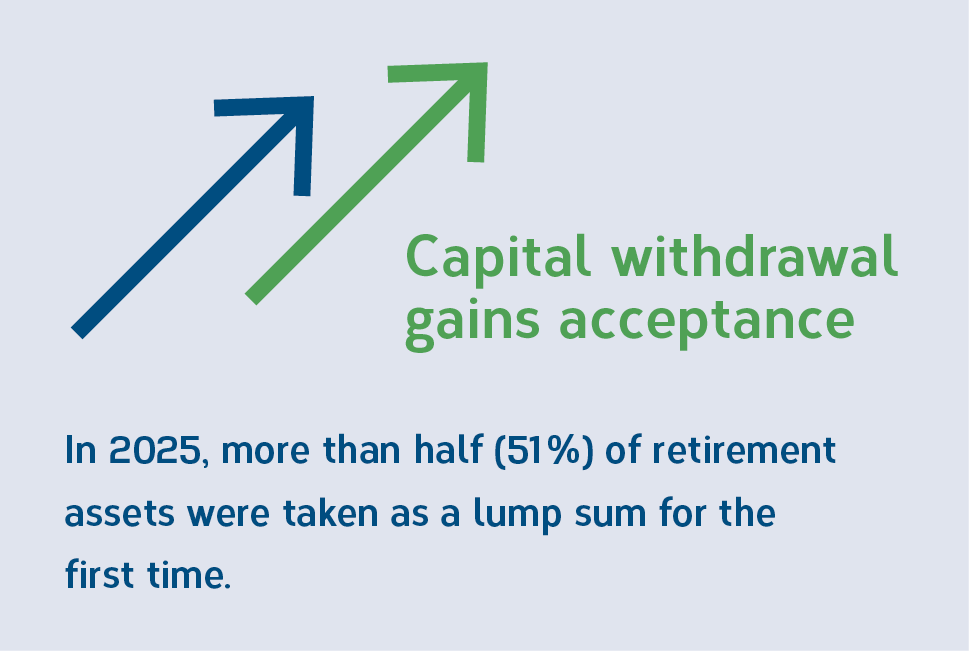
The Swisscanto Pension Fund Study 2026 also confirms the growing importance of lump sum withdrawals. According to the study, more than half of all retirement benefits paid out are now taken as a lump sum. Measured by the volume paid out, lump sum withdrawals have thus continued to gain ground relative to annuities.
Notably, the study finds that this trend can only partly be explained by the decline in conversion rates in recent years. Pension funds with lower conversion rates do not necessarily show higher lump sum withdrawal rates. This suggests that, alongside financial conditions, individual considerations play a particularly important role. These include the desire for financial flexibility, the opportunity to invest or bequeath one’s retirement assets oneself, as well as tax and health-related considerations.
The choice between a lump sum and an annuity is therefore not determined solely by the level of the conversion rate, but to a large extent also by the personal circumstances and preferences of the insured.
Not everyone is an experienced investor
Many people who take a lump sum lack both the knowledge and the experience needed to manage a large portfolio professionally on their own. Taking too little investment risk can lead to a loss of purchasing power and insufficient returns over the long term; taking too much risk can become a problem, particularly if markets crash shortly after retirement. In addition to one’s financial risk capacity, it is therefore also crucial how well one can cope emotionally with market fluctuations.
Choosing the right advisor is key
Those who do not wish to manage their assets themselves depend on professional asset managers. But this, too, carries a risk: finding a competent, fair and truly independent advisor is neither a given nor quick. Besides individual advice, transparency is essential – about how the advisor is paid, which products are used and what potential conflicts of interest exist. Inexperienced investors in particular face a dilemma: they need expertise in order to judge whether the advice they receive is actually good.
Don’t underestimate costs
The costs of investing also play a central role. Management, advisory, product, custody and transaction fees reduce returns year after year. Even an annual charge of 1 percent amounts to CHF 10,000 per year on assets of one million francs. Over decades, this effect is further amplified by the forgone returns on the fees paid. A simple, transparent and low-cost investment strategy therefore offers considerable advantages.
Structured planning is what matters
A successful lump sum withdrawal requires more than a good investment portfolio. What is needed is a long-term financial and withdrawal plan: Which expenses need to be covered? What income will come from the AHV (state pension) and other sources? How much liquidity is required? How will the assets be invested? What happens in the event of a stock market crash? And how long does the capital need to last?
Conclusion
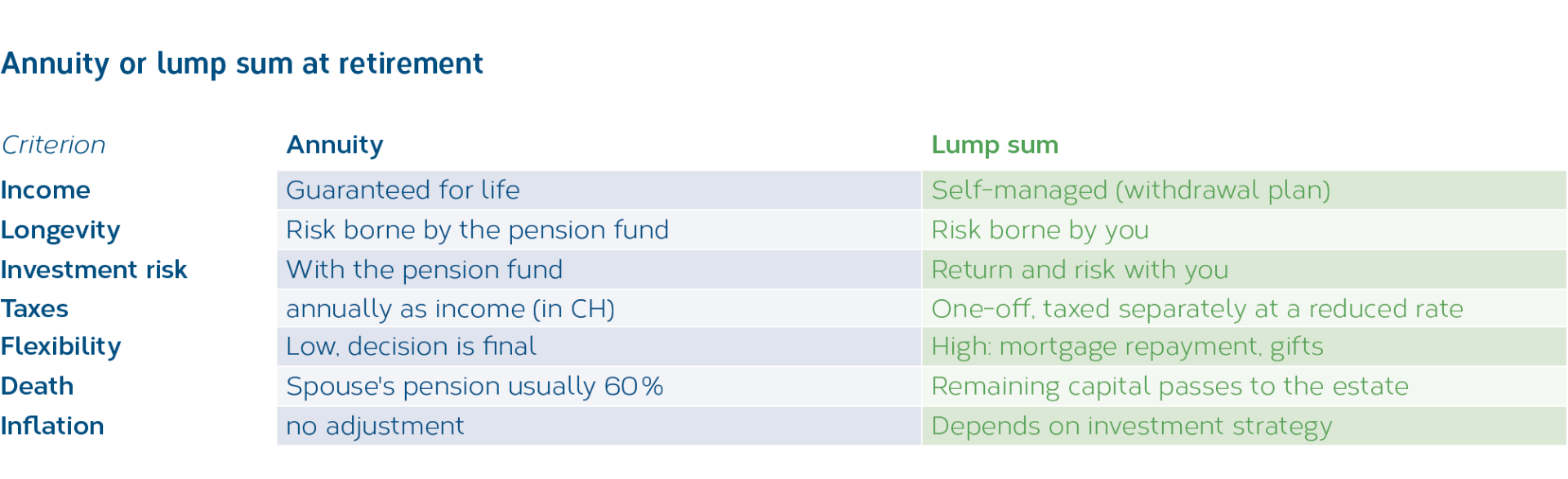
A lump sum withdrawal offers freedom, flexibility and the opportunity to pass on wealth. An annuity, on the other hand, offers security, simplicity and a lifelong income. Those who opt for a lump sum are therefore not only choosing greater freedom, but also taking on responsibility for investment, withdrawals, costs and risks. For many retirees, a combination of annuity and lump sum can be a sensible middle ground.
LMM COMPASS
With our newsletter we provide information about the current situation on the financial markets, current investment topics and LMM.